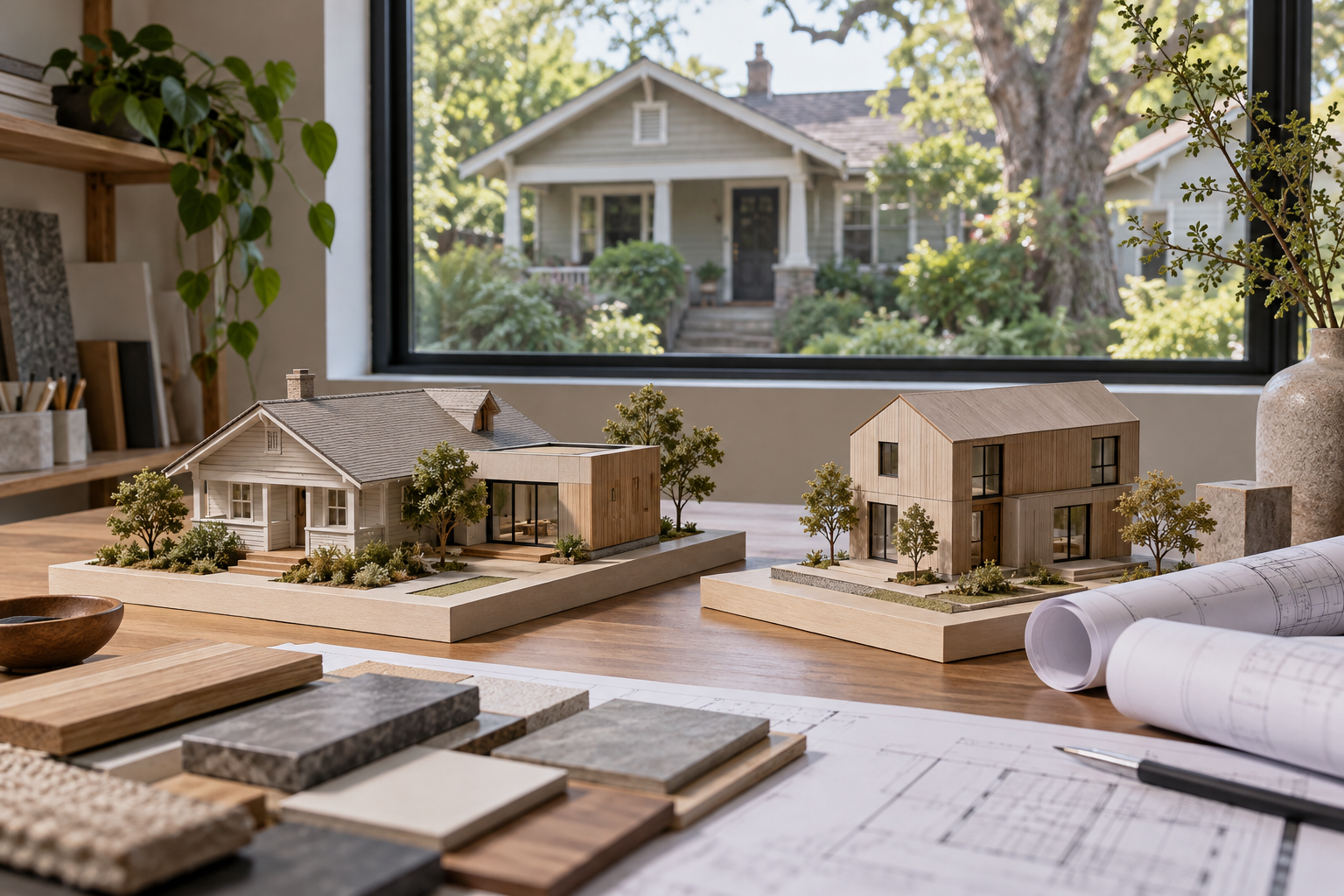
Compare remodeling and rebuilding with the same household brief, building assessments, site constraints, and complete project scope. Include design, approvals, temporary housing, site work, construction, and uncertainty. A feasibility study with comparable options is more useful than comparing two headline construction prices.
When a house no longer fits, it is tempting to frame the choice as a simple cost comparison: remodel or rebuild. The better starting point is what the existing house can reasonably become. Condition, layout, site restrictions, and the disruption you can tolerate all affect the decision before finishes enter the picture.
Write down what has to change
Separate essential needs from preferences. An accessible entry, another bedroom, or a workable kitchen may be essential; a particular ceiling detail may not be. Include the parts of the house you value and would prefer to retain.
Use the same brief for both options. Comparing a modest renovation with an entirely upgraded new house will not tell you which route better meets your actual needs.
Understand the existing building
Arrange appropriate assessments of structure, roof, moisture issues, and major systems. Ask professionals to distinguish known problems from items that require further investigation. An initial walk-through cannot reveal everything behind a wall.
For either route, have the design team check applicable site and planning constraints. Demolishing an existing building does not guarantee that the same footprint or arrangement can be rebuilt. Confirm local requirements rather than relying on a neighboring project’s experience.
Compare complete scopes
Ask for estimates that identify what is included, excluded, and still an allowance. Consider design fees, approvals, site work, utility changes, demolition or disposal, construction, and temporary living arrangements where needed. A headline construction figure is not the entire project budget.
Treat unknown conditions explicitly. Ask how changes will be documented and approved, and what investigation could reduce uncertainty before work begins. Use local, current proposals rather than converting a Brazilian cost per square meter into a U.S. construction budget.
Consider time and disruption
A renovation may let you retain valued parts of the home, but working around an occupied house can complicate daily life. A rebuild offers different design possibilities while usually requiring a separate place to live. Ask each team to explain its sequencing and the assumptions behind the schedule.
Do not choose on a promised resale return alone. Compare how well each option meets the household’s needs, the uncertainties you are accepting, and the level of maintenance expected afterward. The next useful step is often a feasibility study with comparable options, not a final commitment to either route.
Prepare one brief for both options
List the spaces and functions you need, then distinguish essential changes from preferences. Include the parts of the existing home you value, such as a particular room, a mature garden, or the relationship to the street. Both remodeling and rebuilding should be evaluated against that same list.
Avoid allowing the new-build proposal to grow into a different project while the renovation remains tightly limited. If one option includes an additional bathroom, upgraded systems, and larger rooms, those differences must be visible. Otherwise, the comparison may appear to prove a financial point while actually comparing different outcomes.
For an illustrative household, the essential needs might be a workable entry, an additional bedroom, and improved kitchen storage. A renovation concept and a replacement concept can each be tested against those needs. The goal at this stage is a fair feasibility comparison, not a commitment to the more dramatic design.
Separate known conditions from assumptions
Ask the project team to identify what has been assessed and what remains uncertain. Building structure, moisture history, roof condition, and major systems may need different specialists. Record the limits of each assessment. An early visual review is useful but should not be described as complete knowledge of concealed conditions.
Site constraints deserve the same attention. Ask the appropriate local professionals or authorities what applies to the actual property. The existing building’s footprint, a neighbor’s recent project, or an online zoning summary should not be treated as a guarantee of what can be rebuilt.
For each option, list the investigations that could reduce uncertainty before major commitments. Some information may change the design or the budget enough to justify obtaining it early. This helps the household spend on decisions in the right order rather than choosing finishes while feasibility remains unresolved.
Compare schedules by dependency
Request an outline showing design decisions, approvals, procurement, site preparation, construction, and completion steps. Ask what must happen before each stage begins. A single optimistic completion date does not explain where delay could occur or which choices the owner needs to make in time.
Consider how the household will live during the work. If occupation during a remodel is proposed, ask which spaces remain usable and how access, dust, utilities, and daily routines will be managed. If temporary housing is needed for either option, include that in the comparison using actual arrangements and costs.
Discuss how scope changes are documented and how decisions affect the schedule. The point is not to assume that problems will occur, but to understand the process if new information emerges. A clear communication and approval routine can be as valuable as a detailed finish schedule.
Frequently asked questions about remodeling versus rebuilding
### Is remodeling always cheaper? No universal rule settles the question. The existing condition, required changes, site, local costs, and scope influence the comparison. Ask for proposals that describe equivalent outcomes and include the associated project costs, not only visible construction work.
Does rebuilding guarantee a better layout?
It may create different design possibilities, but site constraints and the quality of the brief still matter. A new plan should be evaluated for daily use, storage, light, and maintenance just as carefully as a renovation. New construction is not automatically a solution to an unclear brief.
Should resale value determine the choice?
It can be one consideration, but it should be evaluated with current local advice rather than a promised universal return. Also compare household fit, uncertainty, disruption, and the expected upkeep of the completed home. Those affect the experience of the project directly.
Record why the preferred route wins
Write a short decision summary stating which needs the option meets, what it preserves or changes, and which uncertainties remain. Keep the comparable scopes and professional assessments with that record. The strongest choice is supported by property-specific evidence and a clear understanding of tradeoffs, rather than by a slogan that remodeling or rebuilding is always the better path.